Difference from Original
0%12.5%≥25%



AutoCache uses an AI agent to find when a model can reuse earlier calculations. After this search, the selected rule runs on its own: no retraining and no more agent calls.
Across three tested image and video models, generation is 1.99–3.14× faster than running without caching. Outputs also stay closer to the uncached results than with the compared caching methods.
Measured generation speedup over uncached inference · DrawBench for images · VBench for video
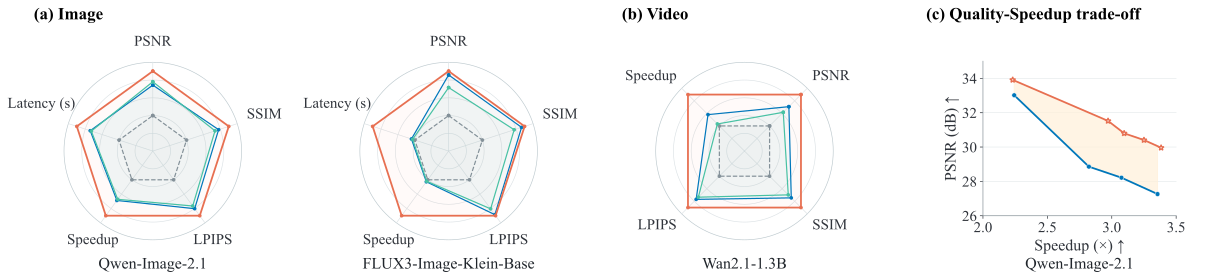
AutoCache Single uses one selected rule per model. It scores better on PSNR, SSIM, and LPIPS than the reported caching baselines on all three models. These metrics compare outputs with the results generated without caching.
The radar plots show the best score for each metric across several rules. Those scores may come from different rules.
| Backbone | Benchmark | Development | Evaluation | Steps |
|---|---|---|---|---|
| Qwen-Image-2.1 | DrawBench | 30 | 170 | 40 |
| FLUX3-Image-Klein-Base | DrawBench | 30 | 170 | 50 |
| Wan2.1-T2V-1.3B | VBench | 124 | 820 | 50 |
| Method | PSNR ↑ | SSIM ↑ | LPIPS ↓ | Speedup ↑ |
|---|---|---|---|---|
| ECAD Fast | 13.21 | 0.446 | 0.463 | 2.28× |
| TeaCache | 19.90 | 0.755 | 0.162 | 1.91× |
| DPCache | 22.97 | 0.828 | 0.106 | 1.81× |
| SeaCache | 25.74 | 0.877 | 0.070 | 2.28× |
| DiCache | 29.12 | 0.923 | 0.043 | 2.01× |
| AutoCache (Ours) | 31.64 | 0.949 | 0.026 | 1.96× |
| Method | PSNR ↑ | SSIM ↑ | LPIPS ↓ | Speedup ↑ |
|---|---|---|---|---|
| DiCache | 26.82 | 0.887 | 0.112 | 2.77× |
| SeaCache | 25.72 | 0.884 | 0.115 | 2.96× |
| AutoCache (Ours) | 27.50 | 0.906 | 0.091 | 3.02× |
Both tests reuse the selected rules without another search.
FLUX3 → FLUX.1-dev: AutoCache has the best output similarity on all three metrics, with 31.64 dB PSNR at 1.96× speedup. SeaCache is faster at 2.28× among the 50-step methods.
DrawBench → GenEval 2: The same Qwen rule reaches 27.50 dB PSNR at 3.02× speedup, ahead of DiCache and SeaCache on all three similarity metrics and speed.
@misc{shen2026autocache,
  title={{AutoCache}: Agent-Designed Caching for Image and Video Generation},
  author={Shen, Canyu and Chen, Yang and Zhu, Gezhi and Zhou, Xuemei and Long, Teng and Hu, Vincent Tao},
  year={2026},
  howpublished={Research preprint},
  url={https://vibe-hust.github.io/autocache_page/}
}